The Bard MFA portfolio requirements look generous at first. They allow recent work, work-in-progress, cross-disciplinary material, and different submission quantities by discipline. However, the common misconception is that this openness means Bard wants a broad sample of everything an applicant can do.
That mistake matters. Bard is not asking for a general display of competence. Instead, it is asking whether an artist can enter a low-residency, artist-run, critique-heavy structure and use that pressure with intelligence.
The portfolio has to prove more than quality. It has to prove liveliness, discipline, self-direction, and the capacity to think through work while it is still unstable. Bard’s own structure makes this clear: the MFA takes place over three intensive summer residencies, with two off-campus independent study periods between them. It is not a conventional academic-year MFA.
Why Bard MFA Is Not a Conventional Studio MFA
Bard’s Milton Avery Graduate School of the Arts describes itself as a nontraditional school for interdisciplinary study in the visual and creative arts. Its programme page states that students are in residence for three consecutive summers, while independent work continues off campus between summer sessions.
This structure changes the admissions logic. Bard is not built around weekly technical instruction, year-round studio monitoring, or a single supervisory relationship. Instead, it concentrates contact into dense periods of critique, conversation, caucus, seminar and presentation.
Therefore, the applicant must already have an active practice. A portfolio that looks technically competent but dependent on constant direction will struggle. So will a portfolio that appears polished but inert.
For this reason, Bard’s openness is demanding. It gives applicants room to show range, but it also exposes whether they can make decisions without a conventional course structure holding them together.


Bard MFA Portfolio Requirements: The Open Brief Is the Test
On the official Bard MFA application page, applicants must choose one primary discipline. The options include Moving Image, Music/Sound, Painting, Photography, Sculpture and Writing. Although work may span media, each application goes to a faculty committee in the chosen discipline.
This is one of the most important admissions clues. Bard supports interdisciplinary practice, but it does not reward vagueness. A painting applicant may include video, installation or text. However, the work still has to make sense through painting’s questions: surface, support, image, colour, material, gesture, reproduction, display or historical inheritance.
Similarly, a photography applicant may submit spatial, moving-image or materially experimental work. Nevertheless, the application must show why photography remains the central pressure point.
The portfolio numbers matter, but they are not the deepest requirement:
- Painting: 15 to 20 images or short audio/video files.
- Photography: 20 images or short audio/video files.
- Sculpture: 25 images or short audio/video files, including recent and older work.
- Moving Image: up to 15 samples, with total time-based material capped at 30 minutes.
- Writing: 15 to 20 pages, with optional additional media.
However, Bard’s broader instruction is more revealing. The portfolio should show the applicant’s best work from the past three years, with emphasis on the past 12 months. Work-in-progress is welcomed, yet Bard advises against submitting an entire portfolio from one series.
That means reviewers want movement. They want to see a practice forming questions, testing methods, and changing under pressure.
The Real Mistake: Confusing Coherence with Repetition
Many applicants misunderstand coherence. They think a strong MFA portfolio should look visually consistent from first image to last. As a result, they submit 18 works that prove style but not development.
At Bard, that can become a liability. The portfolio should not behave like a brand presentation. It should behave like a practice with a centre of gravity and active edges.
A coherent Bard portfolio may include:
- a central body of recent work;
- detail images that show material behaviour;
- installation views that clarify scale and site;
- related studies that reveal decision-making;
- adjacent media when it sharpens the central enquiry;
- one or two older works only when they clarify development.
By contrast, weak portfolios often make one of two errors. Some are too narrow, showing only finished works in one mode. Others are scattered, moving across media without a convincing reason.
The stronger submission sits between those failures. It lets reviewers understand the artist’s discipline, while also showing where that discipline is being stretched.
Bard Wants Discipline, Not Medium Purity
Bard’s disciplines page states that each student focuses on one primary form of expression, while every student may work in any medium and access facilities across departments during the summer. It also says entering students should have working practice and technical knowledge in their field.
This combination is crucial. Bard does not confuse discipline with medium purity. Instead, discipline functions as a way of thinking.
For painting, Bard explicitly supports expanded approaches involving installation and multimedia. Therefore, an applicant working with canvas, projection, wall drawing, print, sound or found material can still apply through painting. However, the work must show why painting remains the operative field.
For sculpture, Bard emphasises form, material, ecological, political, psychological, historical and embodied frames. Therefore, sculpture applicants need more than objects. They need work that understands how form acts in space, site, body and social context.
For photography, Bard treats content, form and material as equally involved in making meaning. Consequently, a photography portfolio can include analogue process, installation, moving image or sculptural image-work. Yet it still needs command of photographic thinking.
What Work-in-Progress Can Prove
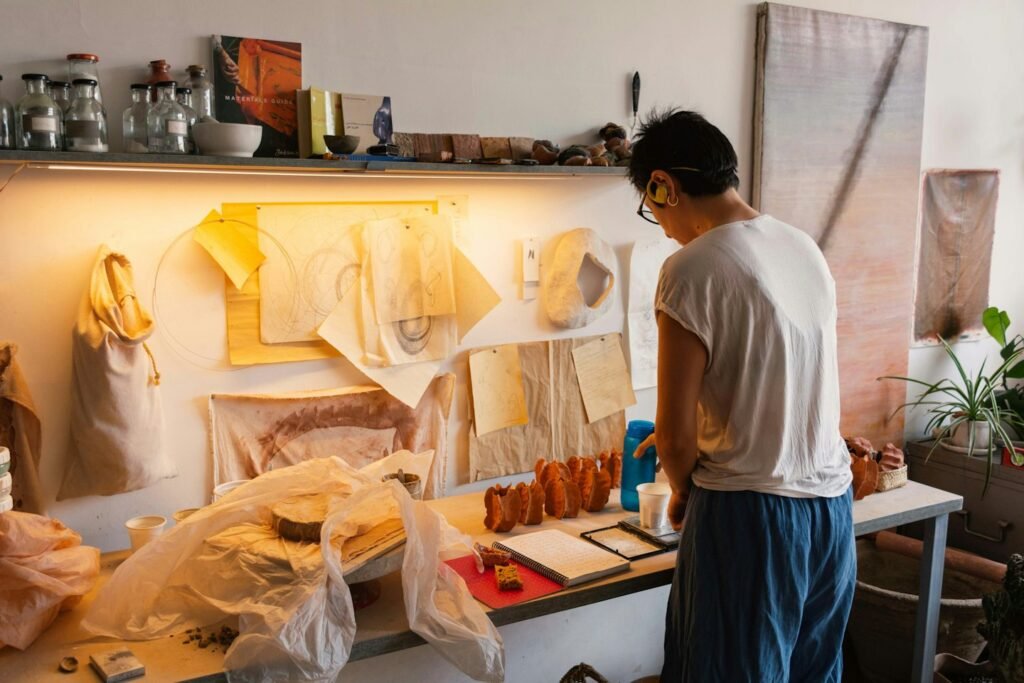
Bard welcomes work-in-progress, but applicants should not treat this as permission to upload weak process material. A half-made work is not automatically more honest or more experimental. Sometimes it only shows uncertainty.
Strong work-in-progress reveals decisions. It shows what changed, what resisted closure, and what problem the artist is still pursuing. For instance, a painting detail may show how a surface has been scraped, rebuilt or contaminated by another material. A sculpture test may reveal how a support system changes the object’s relation to gravity or site.
However, weak process images behave like filler. They appear in the portfolio because the applicant does not have enough resolved work. Reviewers can usually see the difference.
At Bard, unfinished work should make the reviewers want to continue the conversation. It should not ask them to imagine a practice that is not yet visible.
Applicants who are uncertain about what to include often need a rigorous external read before submission. Cadmium’s MA and MFA portfolio support is designed for applicants whose work has promise, but whose portfolio still reads as unresolved, repetitive or unclear in its institutional fit.
Bard’s Critique Structure Shapes the Portfolio Standard
The portfolio standard makes more sense once you understand Bard’s teaching structure. Bard does not offer classes in technique, art theory or history because the summer sessions are brief and intense. Instead, instruction happens through Conferences, weekly Caucus, Seminar, Presentation, Independent Study and the Master’s Project.
The Conference is particularly revealing. Bard describes it as the heart of student activity, and first-year students are expected to meet at least 20 faculty members during the eight-week summer session.
Therefore, the application must show conversational stamina. Can this applicant present work repeatedly? Can they absorb contradictory feedback? Can they stay attached to their own question without becoming defensive or vague?
The portfolio is not just evidence of past achievement. It is evidence that the work can generate two years and two months of meaningful dialogue.
This is why a portfolio built only from finished outcomes may feel too closed. Conversely, a portfolio of random experiments may feel unready. Bard needs work that can withstand critique and continue to develop.
What Bard’s Mission Reveals About Admissions
Bard’s mission gives unusually direct admissions evidence. It prioritises conversation over hierarchical instruction and describes authority as dispersed across many voices. It also values reciprocity, trust, difference and experimental practice guided by other artists.
This means the successful applicant is not simply talented. They must be able to choose, filter and use feedback. Moreover, they must contribute to a community rather than merely consume its prestige.
This point matters in the personal statement. Many applicants write that they want an “interdisciplinary environment”. That phrase is too thin for Bard. The statement must explain why this particular structure is necessary for the work now.
For example, a painting applicant might argue that their work is testing the instability of painting between image, object and site. A sculpture applicant might explain why their material practice needs dialogue with sound, writing or moving image. A photography applicant might show how analogue process, archive and installation have opened a problem that cannot be resolved inside a conventional image-based programme.
The statement should not decorate the portfolio. It should make the portfolio’s pressure legible.
The Personal Statement Must Not Replace the Work
Bard asks for a one-to-two-page personal statement discussing the applicant’s work, artistic goals, personal and critical context, reasons for wanting Bard, and what they hope to gain from graduate study.
This is a precise brief. However, applicants often misuse the personal context. They write autobiography instead of artistic analysis.
Personal material can matter, but only when it illuminates the work. A family history, migration history, illness, political event or community context should not sit beside the practice as explanation. Instead, it should clarify why the work takes its form, material, scale, image system or method.
The best Bard statements answer four questions:
- What is the work doing now?
- What personal and critical conditions shape it?
- Why does this work need Bard rather than a conventional MFA?
- What will the applicant do with critique, independent study and cross-disciplinary pressure?
If the writing is weaker than the work, the application becomes unstable. Cadmium’s Writing and Research Mentorship helps applicants produce statements that keep the emphasis on the work, rather than turning the application into generic admissions language.
Selectivity: Why Openness Does Not Mean Ease
Bard does not require the GRE. It has no GPA requirement, and an undergraduate degree is not required if life experience takes its place. However, this openness should not be mistaken for softness.
Bard’s FAQ states that, in 2016, the programme received more than 350 applications, invited 70 people to interview, and admitted 28. It also states that each discipline accepts around four to five students each year, with painting described as the most competitive discipline.
This creates a specific admissions landscape. Bard may consider non-linear applicants, self-taught artists, older applicants and applicants without standard academic profiles. However, those applicants still need to show graduate-level artistic seriousness.
For parents, this is the point to understand. Bard’s flexibility is not a safety net. It is a way of finding artists whose formation may not fit a standard academic route, but whose work is already operating with force.
For applicants, the implication is direct. You do not need a conventional background. Yet the work must look capable of surviving a highly demanding critical environment.
What Recent Bard Thesis Work Suggests
Applicants should study Bard’s public thesis material because it reveals what the institution celebrates after admission. The Bard MFA thesis exhibition page links to recent exhibition documentation, while the Class of 2026 thesis exhibition, Double Take (July 2025), brought together 22 candidates across Moving Image, Music/Sound, Painting, Photography, Sculpture and Writing. The exhibition text emphasised careful attention to methods and materials, slow looking, close listening and work that rewards sustained attention.
This matters for portfolio strategy. Bard does not appear to reward spectacle for its own sake. Instead, its public language favours material deliberation, expanded discipline, and works that ask the viewer to stay with them.
Recent Bard thesis examples include expanded painting, materially experimental photography, and sculpture that crosses into image, site and object relations. The recurring pattern is a seriousness of relation between material, method, history and display.
Applicants should not imitate thesis work. That would be a weak reading of the evidence. Instead, they should ask sharper questions. Why this material? Why this scale? Why this mode of display? Why this relation to body, sound, archive, surface, image or site?
Common Reasons Bard MFA Applications Fail
Bard applications often fail because applicants misread the institution. They submit the kind of portfolio that might work elsewhere, but not inside Bard’s particular ecology.
The most common failures are specific:
- A portfolio that is too polished. The work looks finished, but it does not show current pressure.
- A portfolio that is too repetitive. The applicant proves consistency, yet shows little development.
- A portfolio with weak disciplinary placement. The work crosses media, but the chosen field remains unclear.
- A statement that over-explains biography. Personal history replaces artistic analysis.
- Poor documentation. Reviewers cannot understand scale, surface, material behaviour or installation logic.
- Careerist misfit. The application frames Bard mainly as access to prestige, rather than as a demanding critical structure.
The Brooklyn Rail’s feature on Bard’s low-residency MFA describes a programme built around practice-based conversations rather than classes, syllabi and grades. That external account aligns with Bard’s own emphasis on critique, conversation and independent work.
Therefore, applicants should not make the portfolio merely impressive. They should make it available to thought.
How to Build a Stronger Bard MFA Portfolio
The strongest Bard portfolios tend to show a live artistic problem. They do not simply state a theme. They allow reviewers to see how the problem changes the work.
A painting applicant might show how images become unstable when moved between canvas, wall, print and installation. A sculpture applicant might show how a material carries ecological, bodily or architectural implications. A photography applicant might show how the photographic image becomes chemical, spatial, archival or performed.
In practical terms, the portfolio should do three things at once. First, it should establish the primary discipline. Next, it should show pressure on that discipline. Finally, it should show recent development rather than static accomplishment.
This is where many applicants need decisive editing. A weaker work may be technically competent, yet flatten the application. A process image may be interesting in the studio, yet useless for admissions. An older work may explain development, but it may also drag the portfolio backwards.
A portfolio review can be useful when the question is not “is this good?” but “what is this work asking Bard to believe?”
Preparing for the Bard MFA Interview
Bard interviews selected candidates by discipline. The official application page states that applications and portfolios are reviewed by faculty within the chosen discipline, with approximately 12 candidates per discipline invited to interview.
The interview should not become a performance of certainty. Bard’s structure depends on dialogue, so the applicant must show both direction and permeability.
Prepare to discuss:
- why you chose the discipline;
- what your most recent work is testing;
- which works failed, and why;
- what you read, watch, listen to or look at;
- how you respond to critique;
- what you would pursue during independent study;
- why Bard’s low-residency structure matters now.
However, do not memorise a script. A scripted interview usually sounds brittle. Instead, learn to speak from the work itself: material, process, scale, form, context, display and decision.
The strongest answers hold tension. They show that the applicant knows what they are doing, but has not closed the work prematurely.
Is Bard Right for Every MFA Applicant?
Bard is not right for every strong artist. That is not a criticism. It is the reason applicants need to understand the programme before applying.
A student who wants regular technical classes, year-round studio access, constant faculty contact or a traditional campus rhythm may prefer another MFA. Similarly, an applicant who wants an urban art-school network, weekly professional visits or market-facing visibility may find Bard’s ethos too oblique.
However, Bard can be powerful for artists who already have momentum. It suits applicants who need intense critical interruption, then enough time away from the institution to test what remains.
This is especially relevant for mid-career artists, teachers, recent graduates with unusually strong self-direction, and artists whose practice sits between disciplines without losing its centre. Cadmium’s Creative Mentorship for Artists can also support applicants who need to define the practice itself before deciding whether Bard, another MFA, or a non-degree route is the stronger strategic move.
Not Sure Whether Your Bard MFA Portfolio Can Withstand Critique?
The Bard MFA portfolio requirements are difficult because they appear open. Yet the real standard is exacting. Bard wants evidence that an applicant can enter a low-residency, cross-disciplinary, conversation-led MFA and use that structure with seriousness.
A portfolio built only on technical polish may not be enough. Similarly, a portfolio full of disconnected experiments may miss the point. The strongest Bard applications show recent artistic pressure, discipline-specific knowledge, material intelligence, self-direction and the ability to speak about work without closing it down.
Cadmium works with Foundation, BA, BFA, MA, MFA and PhD applicants through an online-first, artist-led admissions mentorship platform. Our mentors include practising artists and admissions specialists with extensive experience across UK, US and international art school applications. Cadmium students have received offers from more than 40 leading art schools worldwide.
For Bard applicants, Cadmium’s Portfolio and Admissions Mentorship focuses on identifying weak, repetitive or unresolved work, clarifying the central artistic enquiry, refining how the portfolio reads, strengthening documentation, and developing a statement that makes the practice institutionally legible. Where writing is the weaker part of the application, our Writing and Research Mentorship helps applicants articulate the work with precision, context and relevance.
If your Bard application is approaching and the portfolio still feels over-polished, scattered or difficult to explain, this is the moment to get a sharper read. You can book a 1h expert consultation to discuss your route, deadline and which Cadmium programme is the best fit.
A stronger Bard submission usually begins with one uncomfortable question: can the work survive being placed inside a dense field of contradictory attention?