
The SAIC MFA Studio portfolio requirements look deceptively open. That is the first trap. Many applicants read “15–20 images” or “up to 10 minutes of time-based work” as permission to submit a broad sample of their strongest-looking work. However, SAIC is not asking for a portfolio archive. It is asking whether your practice can enter a research-led, critique-heavy, departmentally grounded but porous MFA environment.
SAIC’s MFA in Studio is a 60-credit programme across 12 departments. Students enter through a home department, yet the school encourages movement across departments, advisors, seminars and facilities. Therefore, the portfolio must do two things at once. It must show a clear artistic position. It must also show that the position can expand under pressure.
This is why technically polished work can still fail. Similarly, experimental work can look weak if it appears random. SAIC wants evidence of inquiry, material judgement, independence and the ability to contribute to critique culture.
For applicants who need a sharper read on whether their portfolio is MFA-level, Cadmium’s MA and MFA portfolio support is built around this exact problem: identifying what the work is really asking, where it is thin, and how the application reads under institutional scrutiny.
Applying to SAIC this year? See how we prepare applicants for SAIC.
What SAIC Officially Asks For
SAIC states that MFA in Studio applicants should submit recent work through 15–20 still images, up to 10 minutes of time-based work, or a combination of both. The school also requires a 500–700 word statement, résumé or CV, references, transcripts and an e-portfolio through SlideRoom. The official SAIC MFA in Studio admissions page gives the most current requirements and should be checked before submission: SAIC MFA in Studio admissions information.
However, the numbers are only the surface. SAIC also says MFA Studio students work beyond their home departments and engage with graduate critiques that alternate between discipline-specific and interdisciplinary panels. This matters because admissions reviewers are not only judging objects. They are judging whether the practice can survive that structure.


The Real Standard: A Body of Inquiry
A strong SAIC MFA Studio portfolio should not behave like a greatest-hits folder. Instead, it should read as a current body of work with pressure behind it.
That pressure might come from material research, social observation, performance, image culture, ecological systems, technology, memory, labour, sound, site or the body. Importantly, the work must make that enquiry visible through form. A statement cannot rescue work that has no internal logic.
Admissions reviewers are likely to ask:
- What is the current body of work?
- Why does it need graduate study now?
- Which department is the right home?
- How does the work use material, image, action, site or duration?
- Can the applicant discuss the work without hiding behind vague theory?
- Can the practice expand across SAIC without losing definition?
This is where many applications weaken. They show talent, but not necessity.
Department Choice Is Not Administrative
SAIC’s MFA in Studio is entered through a studio department. Therefore, department choice becomes part of the application argument.
A textile-installation practice may read differently in Fiber and Material Studies than in Sculpture. A performance-installation practice may need to decide whether Performance, Art and Technology / Sound Practices, or Film, Video, New Media and Animation gives the work its strongest critical home. Likewise, a painter using archives, surfaces and bodily scale must show why Painting and Drawing is the right context, not just the default medium label.
The wrong department can make strong work look misread. By contrast, the right department clarifies the work’s concerns before a reviewer even reaches the statement.
Common SAIC MFA Studio Portfolio Mistakes
The most common mistake is breadth without necessity. Applicants include painting, video, installation, photography and writing because SAIC values interdisciplinarity. However, interdisciplinarity is not a mood. It is a method.
Other frequent problems include:
- submitting a retrospective archive instead of recent work
- relying on technical finish without research pressure
- using captions that omit scale, duration, material or site
- treating the statement as autobiography
- choosing a department because it sounds prestigious
- showing experimentation without a clear question
- overloading PDFs with illegible documentation
- presenting personal history as content without formal transformation
SAIC’s own admissions language stresses research, critique, technical skill, articulate communication, conceptual acuity, insight, independence and generosity. Therefore, the application must show more than ability. It must show artistic judgement.
The Statement Must Clarify the Portfolio
The SAIC statement is not a decorative essay. It asks applicants to describe their work, explain how they came to focus on a body of work for graduate study, discuss future directions, and explain why SAIC fits those goals.
That means the statement should not begin with childhood creativity. It should not praise Chicago in general terms. Instead, it should name the central problem in the work and explain why SAIC’s structure is necessary.
A stronger statement might connect the practice to:
- a home department
- cross-department advising
- graduate critique
- seminars and art history study
- facilities
- exhibition, screening or performance contexts
- the Art Institute of Chicago’s collection, where relevant
- Chicago as a working cultural environment
For applicants whose writing is weaker than the work, Cadmium’s Writing and Research Mentorship helps refine artist statements, research positioning and application language without flattening the practice into admissions cliché.
Documentation Can Change the Reading
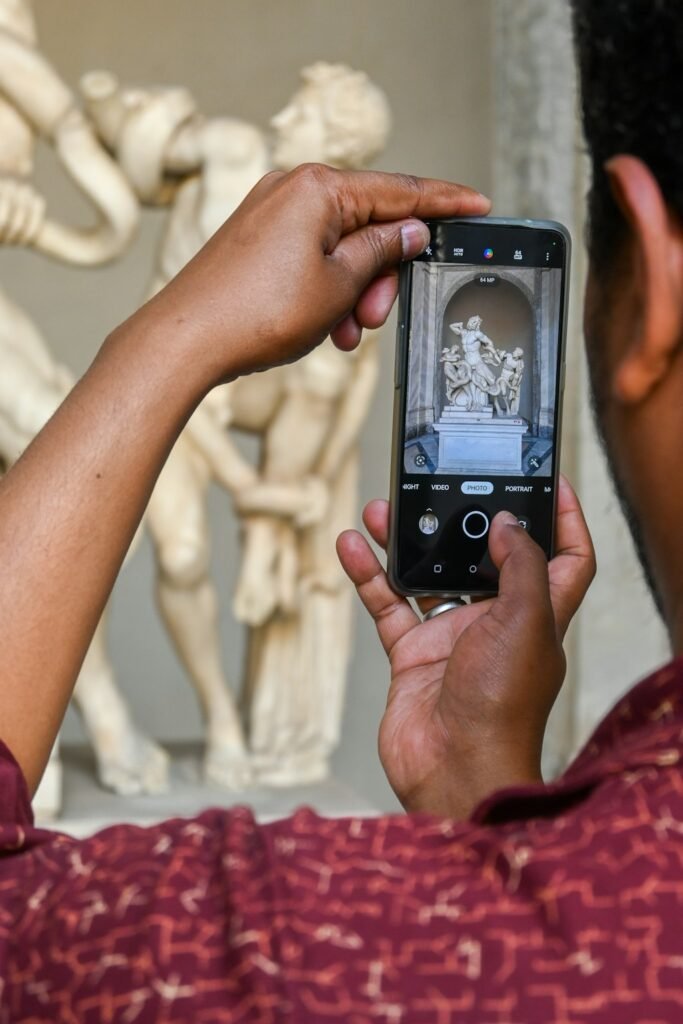
SAIC’s SlideRoom format makes documentation part of the work’s legibility. Poor documentation does not only look unprofessional. It can actively distort the practice.
For example, an installation without scale becomes an image. A performance without duration becomes a still. A sound work without listening context becomes an attachment. Similarly, a sculpture photographed against visual clutter can lose its material intelligence.
Applicants should treat each upload as evidence. Captions should clarify material, scale, year, duration, location and role. Where work is collaborative, the applicant’s contribution must be explicit.
The official SAIC graduate application process also notes that each selected programme or studio department requires its own programme-specific application and e-portfolio. Therefore, recycled submissions are risky: SAIC graduate application process.
What Graduate Work Reveals
SAIC’s graduate exhibitions show why the admissions portfolio must be more than polished samples. The 2026 Graduate Shows present thesis exhibitions and festivals, with the school describing work that resists simplification and proposes forms of enquiry that remain open, critical and generative. SAIC Graduate Shows 2026 gives a useful public view of this culture.
Graduate Exhibition One, for instance, presents new and ambitious work by MFA candidates in SAIC Galleries. This public-facing structure matters. SAIC is preparing artists whose work can enter exhibition, performance, screening, publication or activation contexts, not just studio storage. Graduate Exhibition One makes that expectation visible.
Consequently, applicants should ask whether their portfolio already contains the seeds of public presentation. If not, the work may feel underdeveloped for SAIC’s MFA ecology.
SAIC Is Not Looking for a Generic Elite MFA Applicant
SAIC differs from Yale, RISD, RCA, Slade or Goldsmiths because its structure is both departmental and porous. The applicant needs a disciplinary home, but also the capacity to work across a large art-school environment.
This produces a specific admissions standard. SAIC does not reward vagueness simply because it sounds experimental. Nor does it reward narrow technical refinement if the work has no research energy. The strongest applicant is grounded but mobile.
In practical terms, the portfolio should show direction without closure. It should make clear what the work is doing now, while leaving enough unresolved pressure for graduate study to matter.
How Parents Should Read the Risk
For parents, the difficulty is often invisible. SAIC’s requirements can look flexible, so the application may appear less demanding than more prescriptive MFA routes. In reality, open requirements often demand stronger judgement.
A parent may see variety and assume range. Admissions reviewers may see indecision. A family may value polish. Reviewers may see work that has stopped asking questions. Conversely, a messy, research-driven practice may need editing, not sanitising.
This is why serious applicants often need critique before they need reassurance. Cadmium’s portfolio and admissions mentorship focuses on how the portfolio reads, which works are weakening the application, and what needs making, cutting or reframing before submission.
Preparing an Application for SAIC MFA Studio?
The SAIC MFA Studio portfolio is difficult because the requirements appear open. Yet the real standard is precise. SAIC wants evidence that an applicant can enter a department-specific, critique-intensive, cross-disciplinary MFA and use that freedom with seriousness.
A portfolio built only on technical polish may not be enough. Similarly, a portfolio full of disconnected experiments may miss the point. The strongest applications show authored direction, material intelligence, research habits, and the ability to speak about work without reducing it to generic statement language.
Cadmium works with Foundation, BA, BFA, MA, MFA and PhD applicants through an online-first, artist-led admissions mentorship platform. For SAIC applicants, we focus on identifying weak, repetitive or unresolved work, clarifying the central enquiry, refining how the portfolio reads, strengthening documentation, and developing a statement that gives the practice sharper definition.
Where the writing is the weaker part of the application, our writing support helps applicants articulate the work with precision, context and institutional relevance. Where the portfolio itself is scattered, our critique-led mentorship identifies what the application is asking admissions to believe, and whether the work supports that claim.
If your SAIC application is approaching and the portfolio still feels over-polished, diffuse or difficult to explain, this is the moment to get a sharper read. You can apply for Cadmium mentorship or book a 1h expert consultation to discuss your route, deadline and application stage.
A stronger SAIC submission usually begins with one uncomfortable question: what does this body of work prove you are ready to test?