Most applicants misunderstand what top art schools are actually assessing.
They focus on improving technique, producing more work, or trying to make each piece “strong” in isolation. The result is usually a portfolio that looks busy and competent, but ultimately lacks direction.
What is being assessed is something else entirely. The question is whether the work operates as a coherent practice. This is the shift we focus on in our portfolio mentorship for art school applications.
This case study shows what that looks like in real terms.
Applying to Goldsmiths this year? See how we prepare applicants for Goldsmiths.
Case study: Foundation student accepted to Goldsmiths BA Fine Art & History of Art
Nawal was 20 and completing a Foundation Diploma when she came to Cadmium. We worked together over the course of a year, at the end of which she was accepted to her first-choice programme: BA Fine Art & History of Art at Goldsmiths.
Before we began, the portfolio followed a familiar structure: each project was organised around artist research followed by a response. The work met the minimum expectations of the course, but it did not hold together as a body of work.
There was no clear position. The references were visible, but they were being copied rather than absorbed. Each outcome existed on its own terms, without building towards anything.
This is where most applicants sit without realising it.

What changed
The shift was not about making better individual pieces. It was about changing how the work was being generated and understood.
We moved away from treating the portfolio as a set of tasks, and instead rebuilt it around her own position. Her experience of living between Saudi, Switzerland, and London, and her interest in feminism and the construction of identity, became the underlying structure.
From that point, the work began to develop differently. References were no longer endpoints. They became material to think with, and the work no longer relied on standard references often repeated in teaching contexts, including widely circulated contemporary artists such as Wangechi Mutu. Decisions about image, material, and format started to align with what the work was actually concerned with.
The portfolio stopped trying to satisfy a course and started to function as a practice. You can see similar outcomes in other successful art school portfolio examples.
Portfolio breakdown: how we built Nawal’s portfolio from scratch to get accepted to Goldsmiths
A consistent position across different works

Across painting and collage, the same set of concerns is being worked through. Identity is not presented as a theme, but embedded in how the work is constructed. The repetition of veiling, fragmentation, and pattern establishes continuity without becoming illustrative.
This is what allows different works to sit together without feeling repetitive.
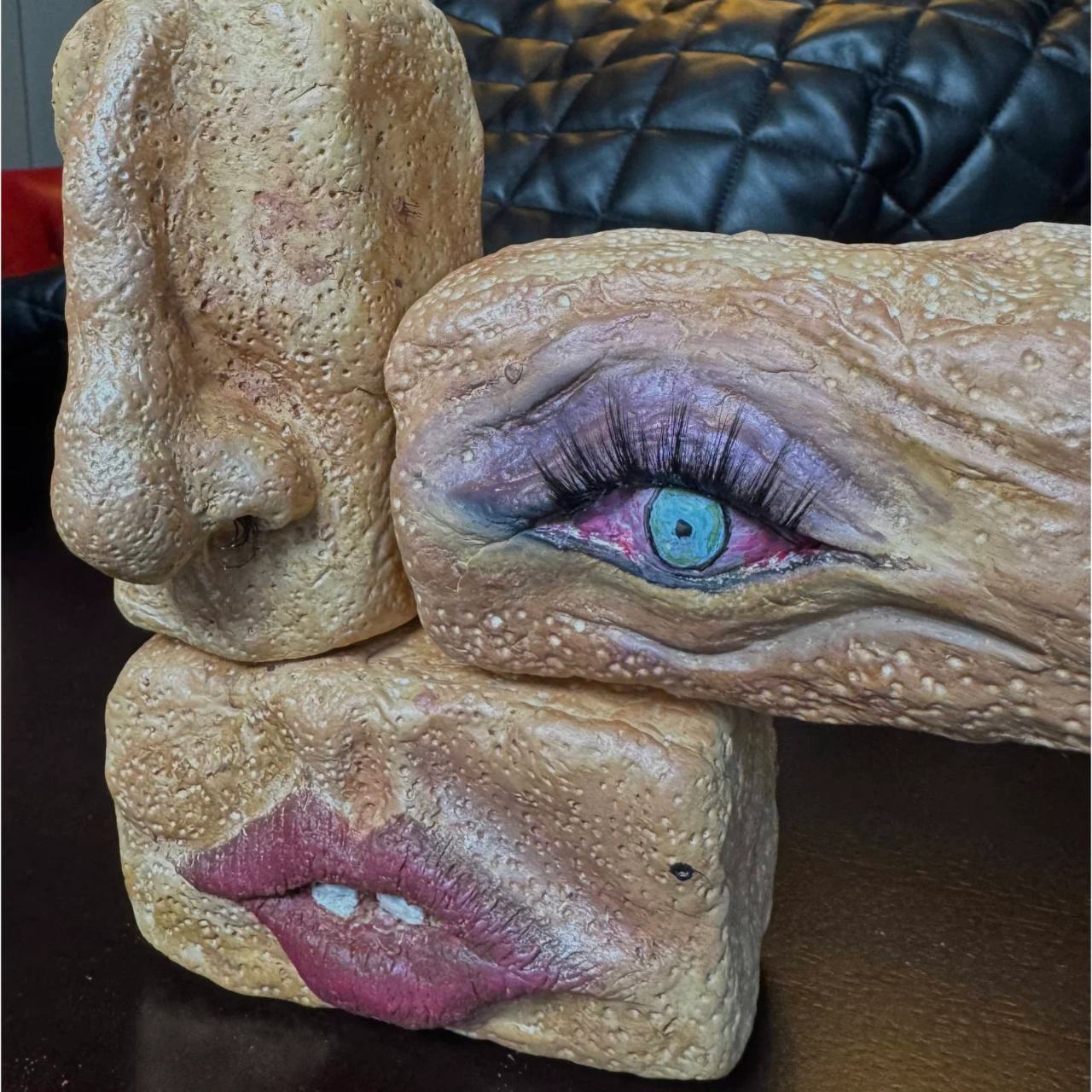
Material is used deliberately, not decoratively

The use of tulle, embroidery, and layered drawing is not an aesthetic choice applied afterwards. It reinforces the logic of the work. Concealment, restriction, and surface become tangible rather than described.
A common mistake is to treat materials as neutral. Here, material and idea are inseparable.
The work is pushed beyond stability

As the portfolio develops, the image begins to fragment. Faces distort, surfaces break down, and the work becomes less fixed. This shows a willingness to push an idea far enough for it to become uncertain.
Work that remains controlled and resolved at all times tends to read as cautious.
Development extends into space
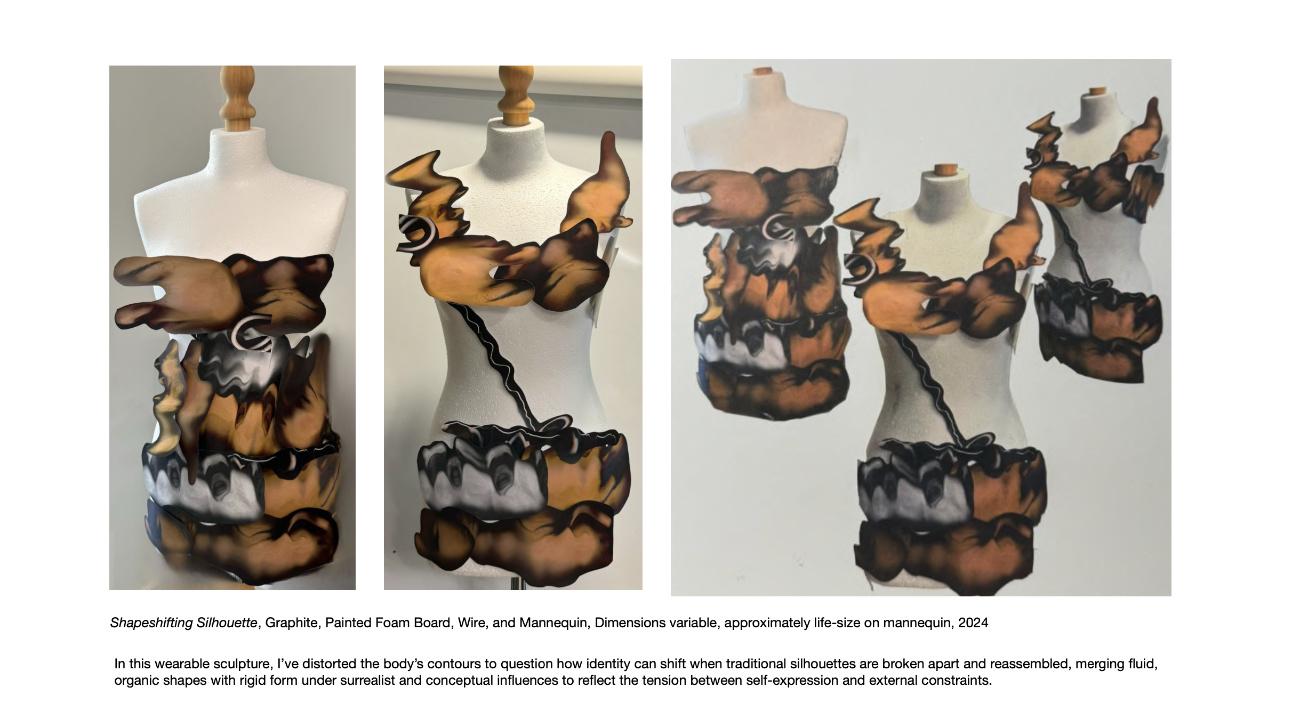
The move into sculpture is not a change of direction. It is an extension of the same concerns into a different form. The body becomes a site where identity and constraint are physically enacted.
This demonstrates development in thinking rather than simply introducing another medium.
Sketchbook work shows actual thinking
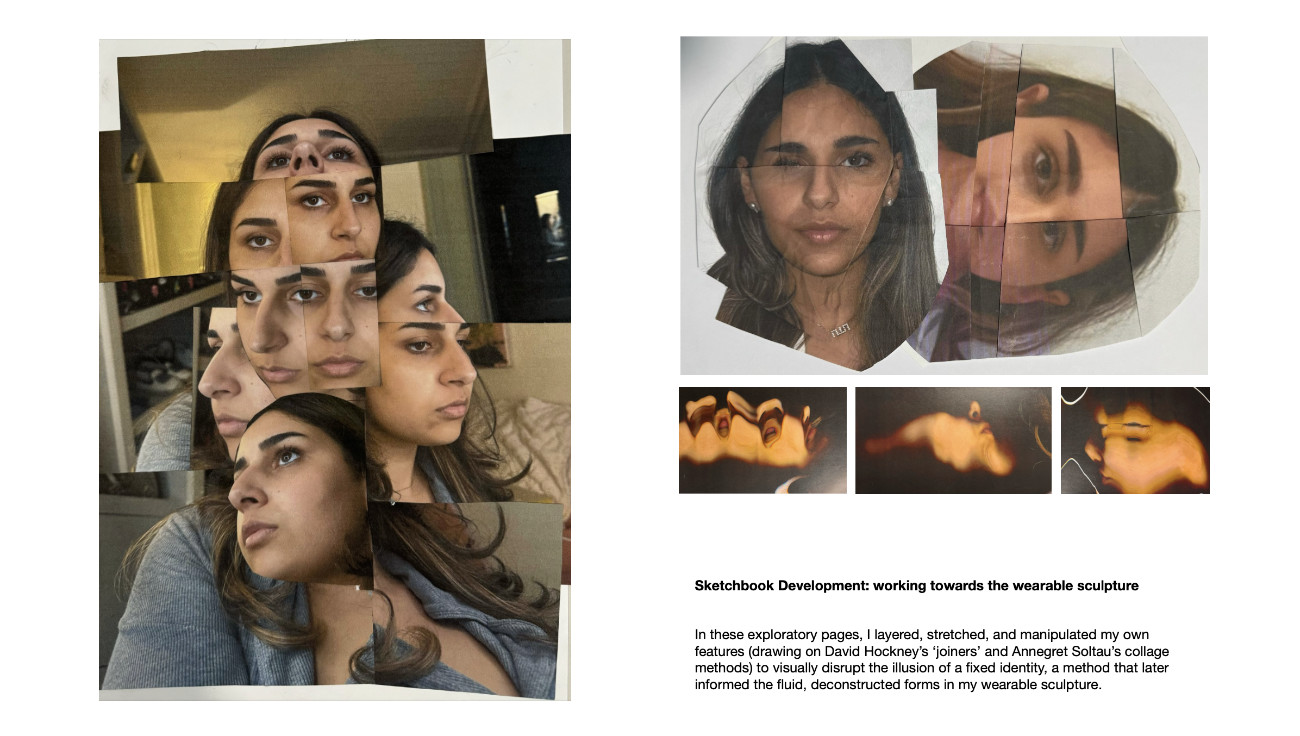
The sketchbook pages are not presented as polished outcomes. They show testing, repetition, and uncertainty. You can see how ideas are being worked through before they are resolved elsewhere.
This matters more than presentation. It shows how decisions are made.
The portfolio resolves as a body of work
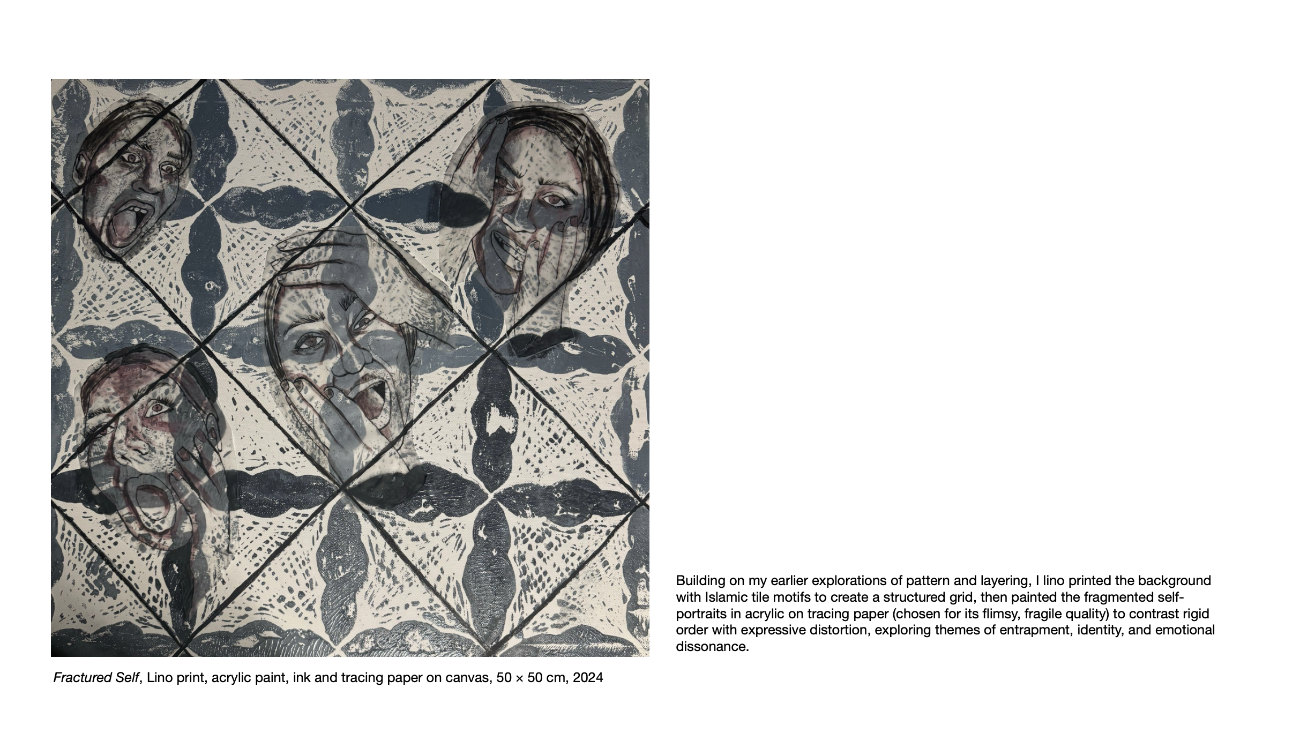
By the final works, the visual language is consistent and the references are no longer visible as sources. The work reads as internally coherent.
At this point, the portfolio no longer feels like a set of projects. It functions as a whole.
What most applicants get wrong
The same issues appear repeatedly.
Students copy artists rather than developing a position. They focus on technique as a way of proving ability and produce large amounts of work without editing or direction. They avoid risk, and often do not spend enough time looking at art, reading, or engaging with wider references.
The result is a portfolio that appears complete, but does not hold together.
What Goldsmiths is actually assessing
The assessment is not based on how technically strong the work is, or how much has been produced.
What matters is whether the work is coherent, whether it has a clear position, and whether it shows self-direction.
If those elements are not in place, adding more work rarely resolves the issue.
Final thoughts
This portfolio was not successful because it was more polished than others. It was successful because it held together. The work had a clear internal logic, and each decision contributed to that.
That is ultimately what distinguishes a strong application from a weak one.
If your portfolio doesn’t yet hold together like this, the issue is structural. You can book a 1h expert consultation to get clear on what needs to change.