A strong CalArts MFA Art portfolio is not simply an impressive set of images. That is the first misconception. Many applicants treat CalArts as if it wants maximum experimentation, but they mistake looseness for freedom, and freedom for lack of judgement.
That mistake matters because CalArts reads openness very precisely. The official MFA Art admissions requirements ask for recent work, personal direction, a 500 to 1,000 word artist statement, a short video introduction, two recommendations and, for shortlisted applicants, an interview. However, those requirements only explain the container. They do not explain how the work is judged.
CalArts is difficult because the application appears generous. Any medium is permitted. Works-in-progress are allowed. Multiple interests are encouraged. Yet, as a result, weak applications often reveal themselves faster. They show inconsistency without enquiry, experimentation without stakes, and writing that tries to sound “conceptual” without locating the work in lived, material or intellectual terms.
For serious MFA applicants, the question is therefore not “Is my work experimental enough?” It is sharper than that. What does the portfolio ask CalArts to believe about your practice, your research habits and your ability to contribute to a demanding peer culture?
Applying to CalArts this year? See how we prepare applicants for CalArts.
Why the CalArts MFA Art Portfolio Is Misunderstood
CalArts describes its two-year MFA Art as a programme based on individualised instruction, mentoring and the flexibility to design a course of study around each artist’s practice. In addition, the programme asks artists to develop critical self-awareness and understand the aesthetic, social and intellectual contexts that inform artmaking.
This means CalArts does not simply reward applicants who can make polished work in one recognisable style. Instead, it looks for artists who can think through practice. The work needs to carry pressure. It should suggest that the applicant can enter critique, revise assumptions, and use the school’s interdisciplinary environment without becoming vague.
However, applicants often misread this culture. They submit fragments, tests, half-started ideas, and disconnected media because they believe CalArts values mess by default. It does not. The difference between productive risk and weak decision-making is visible.
A productive risk opens a question. A weak decision avoids one.
For this reason, CalArts can be more exacting than a school with narrower technical expectations. The application gives you room, but it also makes every decision more exposed.


CalArts Is Looking for Practice, Not Portfolio Theatre
The CalArts admissions page says the faculty want to know what your artistic interests are and how those interests appear in your practice. It also encourages work in a variety of media.
That language matters. CalArts is not asking for variety as decoration. Rather, it wants to see whether different works belong to the same developing intelligence.
A competitive portfolio might include painting, video, installation documentation, drawing and text. However, those forms should not behave like separate applications. They need a shared pressure point. For example, a painter working with domestic memory might also include a video made from family recordings, a sculptural object built from household materials, and drawings that test spatial distortion. The media can change. The enquiry should deepen.
By contrast, a weaker portfolio may include one portrait project, one digital collage, one installation, one performance and one set of abstract paintings, all presented as evidence of versatility. However, if the works do not sharpen one another, the range becomes a liability.
CalArts does not need proof that you can try many things. It needs proof that you can make decisions across many things.
The Official Requirements Are More Revealing Than They Look
CalArts asks for approximately 20 individual slides of images and/or video, preferably of work from the last three years. It welcomes works-in-progress. However, it also warns against pre-formatted portfolios, composite images, PDFs, website links and images that do not fill the slide. Since reviewers cannot zoom in, detail shots must appear as separate slides.
These instructions are not administrative noise. They reveal how the committee looks.
First, CalArts reviews work quickly and comparatively. Therefore, each image must communicate clearly without relying on external navigation. Second, the faculty want to encounter individual works, not a designed brochure. Finally, they want the upload fields to carry titles, captions and descriptions, rather than text laid over the image.
Applicants often treat presentation as secondary to the work. At MFA level, that is naive. Poor documentation does not look casual. It looks like the applicant has not understood how artwork travels through an admissions context.
Common presentation failures include:
- composite slides that compress several works into one unreadable image
- installation shots with no clear sense of scale, material or viewer position
- cropped objects that remove the work’s spatial logic
- over-designed PDFs that make the portfolio feel like a branding exercise
- video links that ask reviewers to leave the application system
- captions embedded into images rather than placed in the required fields
Importantly, CalArts does not ask for slickness. It asks for legibility. Those are different standards.
Personal Work Means More Than “Authentic” Work
CalArts states that it is looking for personal work that gives a sense of who the applicant is as an artist, rather than technical exercises, generic class assignments, figure drawing or still life, unless those works show a personal or distinctive approach.
This is one of the most important lines in the application.
Many applicants translate “personal” into autobiographical. However, personal work does not have to disclose private material. It means the work could not have been made by any competent student following the same brief. It carries authored decisions.
A technically strong figure drawing may still fail here. By contrast, a raw performance document, a strange material test, or a provisional installation may hold more admissions value if it reveals a specific artistic problem.
CalArts is asking: where are you in the work?
That question can be answered through subject matter, but also through structure, rhythm, material, refusal, humour, politics, archive, scale or the way an image withholds information. The applicant’s task is not to perform sincerity. It is to make the work impossible to confuse with generic coursework.
This is where many promising portfolios remain underdeveloped. The applicant has ability, but the work still feels borrowed from school assignments, social media aesthetics or familiar contemporary art gestures. CalArts will notice.
For applicants who need a sharper external read on which works are genuinely authored, Cadmium’s Portfolio and Admissions Mentorship focuses on identifying unresolved, repetitive or overly safe work before it weakens the application.
Works-in-Progress Are Allowed, But They Must Carry Intelligence
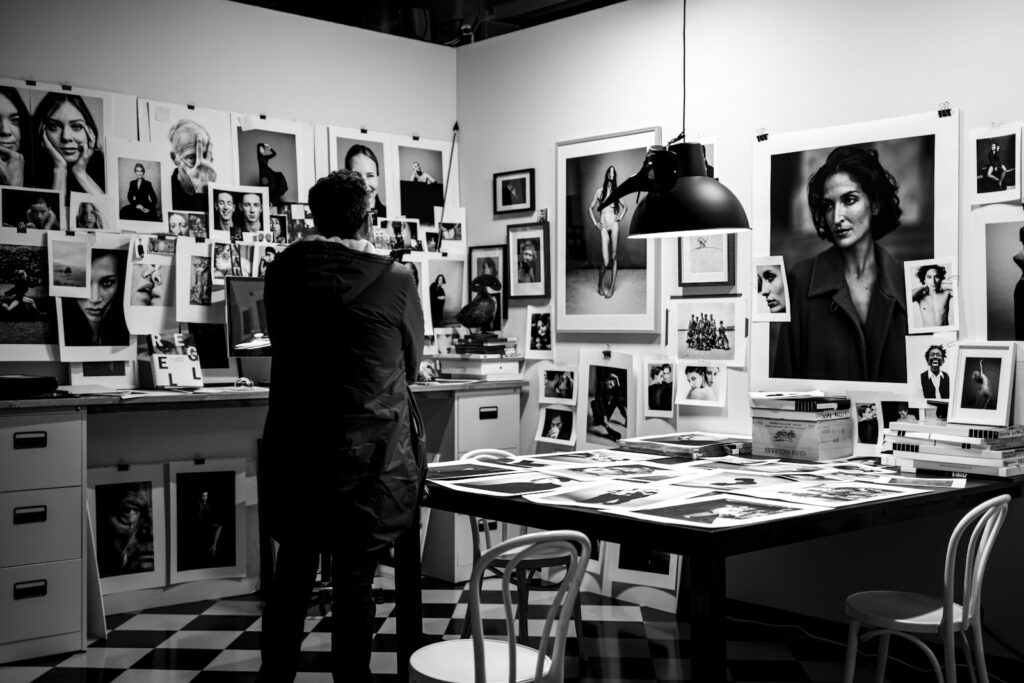
The CalArts MFA Art portfolio may include works-in-progress. However, this should not encourage applicants to include weak unfinished material. The standard is not finish. The standard is whether the unfinished work reveals thought.
A strong process slide can show:
- how an idea changed through testing
- why a material problem matters
- how research enters the work
- what alternatives the applicant rejected
- how a project might develop inside an MFA
Nevertheless, process material should not become filler. A studio wall, notebook page or installation test only helps if it reveals artistic decision-making. Otherwise, it reads as atmosphere.
This distinction is central to CalArts. The School of Art describes rigorous critique, fluent discourse and cross-genre collaboration as hallmarks of its graduate programmes. It also emphasises studios, labs and galleries as places where work is made, tested and shown.
Therefore, the portfolio should feel alive to critique. It should not look sealed. However, it also cannot appear careless. CalArts is interested in artists who can work inside uncertainty, not applicants who use uncertainty as an excuse for weak editing.
The Artist Statement Is Not a Biography
The artist statement must be between 500 and 1,000 words. CalArts asks applicants to address at least three of four questions: their main inspirations, why they are applying and what they expect from the CalArts experience, which faculty they want to work with, and the impact they want the work to have across communities and audiences.
This gives the statement a clear admissions function. It must connect the portfolio to context, research and fit.
However, many MFA statements fail because they explain the applicant’s life instead of the work’s logic. Others produce a cloud of theoretical language. Neither approach helps. At CalArts, writing must do three things at once.
First, it should name the central artistic enquiry without over-defining it. Next, it should show why CalArts is a necessary environment for that enquiry. Finally, it should demonstrate that the applicant can speak to contemporary art, community and audience without reducing the work to a slogan.
A weak statement says: “My work explores identity, memory and space.”
A stronger statement explains what kind of identity, whose memory, what space, through which materials, under what tensions, and why those tensions require further graduate study.
The best statements do not translate the art into generic admissions language. Instead, they sharpen how the work should be read.
Where writing is the weaker component, Cadmium’s Writing and Research Mentorship supports statements, proposals and contextual framing that stay grounded in the practice rather than floating above it.
Why Faculty Fit Must Be Specific
CalArts explicitly asks which faculty applicants would like to work with and why. This is not an invitation to name-drop. It is a test of whether the applicant understands the intellectual and artistic ecology of the school.
A serious answer should connect faculty relevance to the applicant’s work. For example, an applicant might discuss how a faculty member’s approach to moving image, social practice, painting, installation, performance, publishing or critical theory intersects with a live problem in their practice. The connection must be concrete.
However, applicants often make two mistakes. Some mention famous alumni or historical figures as if reputation equals fit. Others list faculty names without explaining what kind of critique, method or context they seek.
CalArts does not need flattery. It needs evidence that the applicant has studied the programme carefully.
This is especially important because the MFA Art curriculum encourages students to move beyond the confines of specific genres, techniques or media. Each student receives an individual studio and works with faculty mentors to develop research trajectories and critical thinking.
Therefore, faculty fit should not sound like consumer preference. It should sound like an artistic necessity.
The Video Introduction Is a Small but Revealing Test
CalArts requires a 30 to 90 second video introduction as the last item in the portfolio. Applicants should speak directly to camera, avoid reading from a script, use no special effects, and speak about their practice in general rather than one specific piece. Cell phone quality is acceptable.
This short video can quietly damage an application.
A scripted video often sounds brittle. A heavily edited video misunderstands the brief. Meanwhile, a video that repeats the artist statement wastes the opportunity. CalArts wants to see how the applicant communicates as a person entering a critique-heavy environment.
The video should not perform charm. Instead, it should show presence. The applicant needs to speak clearly about what they make, what currently drives the work, and what questions remain open.
For CalArts, this matters because cohort culture is not decorative. It forms part of the education. A student who cannot speak about work with directness may struggle in critique, studio visits and peer discussion.
A good video says, in effect: I can enter a serious conversation about my work without hiding behind jargon.
Cohort Fit Is Part of the Admissions Logic
CalArts places unusual emphasis on community. In an article on the 2023 postgraduate exhibition, Michael Ned Holte described the cohort as a decisive and unpredictable factor in shaping the MFA experience. He also noted that students often continue to be one another’s most important audience.
This has admissions implications. CalArts is not only selecting individual portfolios. It is building a room.
That room must contain difference, friction, generosity and seriousness. Therefore, the application needs to suggest how the applicant might contribute to the intellectual life of the cohort. This does not mean being agreeable. It means being present, articulate and productively engaged.
The portfolio can signal this through work that understands audience, collaboration, community or site. The statement can also show awareness of how the applicant’s practice operates beyond private expression. However, applicants should avoid vague claims about wanting a “creative community”. CalArts already knows community matters. The question is what kind of presence you would bring to it.
This is why the interview matters. CalArts states that applicants who pass the preliminary review are invited in March for an interview, and that the interview is required for invited candidates.
By that stage, the portfolio has opened the door. The conversation tests whether the artist can inhabit the work.
Risk at CalArts Is Not Randomness
CalArts has a long-standing reputation for experimental practice. However, the most useful way to understand that reputation is not as permission to do anything. It is a demand to make risk legible.
Hyperallergic’s review of CalArts MFA Open Studios described a culture in which students were encouraged to fail, get messy and try new things. It also contrasted this with MFA models that smooth out rough edges towards formal and conceptual polish.
For applicants, this does not mean unfinished work automatically becomes stronger. Instead, it means the committee may value work that contains unresolved pressure over work that feels market-ready but intellectually closed.
A CalArts-ready risk might involve:
- a material experiment that changes the terms of the project
- an installation that tests audience behaviour
- a video work that refuses conventional narrative
- a performance trace that complicates documentation
- a painting practice that is interrupted by text, archive or object-making
- a research-led project that remains visually unstable for good reasons
By contrast, randomness often appears as sudden changes in medium with no artistic consequence. The applicant may call it experimentation, but the committee sees evasion.
Risk must produce knowledge. Otherwise, it is just activity.
How CalArts Differs from More Polished MFA Routes
Applicants often compare CalArts with other leading US and international MFA routes. However, the distinction is not simply ranking, location or faculty reputation. It is pedagogical temperament.
CalArts’ official programme page foregrounds self-designed study, individual studios, critique, seminars, independent study and social environments. In addition, the broader School of Art highlights cross-genre collaboration and interdisciplinary exchange across visual, performing, media and literary arts.
This has practical consequences. A painter applying to CalArts should not present painting as a sealed discipline unless that closure is itself part of the artistic argument. A sculptor should understand how objects behave in relation to image, performance, site or discourse. A moving image artist should show more than technical editing. They should reveal why time, sound, body or screen matter to the enquiry.
CalArts suits applicants who want to test the boundaries of a practice. It may not suit applicants who mainly want technical refinement in a stable medium. That distinction is not about quality. It is about fit.
Parents and applicants should take this seriously. A prestigious MFA is not automatically the right MFA. At graduate level, the wrong environment can flatten a practice as quickly as the right one can intensify it.
Common CalArts MFA Art Portfolio Mistakes
The weakest CalArts applications usually fail in specific ways. They rarely fail because the applicant lacks effort. More often, they fail because the applicant misunderstands what the school is reading.
The most common mistakes include:
- submitting technical exercises as if skill alone proves readiness
- using multiple media without a clear artistic problem
- over-polishing the portfolio until every productive uncertainty disappears
- including works-in-progress that reveal no decision-making
- writing a statement that could be sent to any MFA programme
- naming faculty without showing real relevance
- using theory to decorate rather than clarify the work
- presenting installation, video or performance documentation poorly
- treating the video introduction as a performance instead of a direct address
- ignoring CalArts’ upload instructions and presentation limits
Notably, these mistakes are connected. A generic statement often accompanies a generic portfolio. Poor documentation often reflects unclear priorities. Similarly, random experimentation often appears when the applicant has not identified the central enquiry.
CalArts does not require a finished artistic identity. However, it does require evidence of seriousness. That seriousness appears through choices.
What a Competitive CalArts MFA Art Portfolio Should Demonstrate
A competitive CalArts MFA Art portfolio should not feel like a greatest-hits folder. It should feel like a practice under pressure.
The work may be uneven in finish. It may move across media. It may contain open questions. However, the admissions committee should sense that the applicant knows what is at stake.
Strong portfolios usually demonstrate:
- a recognisable artistic enquiry, even when the forms vary
- recent personal work rather than generic coursework
- material decisions that carry conceptual weight
- documentation that lets reviewers understand scale, surface and context
- evidence of process where process genuinely matters
- research habits visible through images, captions or statement
- awareness of audience, community or site
- capacity to speak about the work without flattening it
- fit with CalArts’ critique-heavy, interdisciplinary culture
The strongest applications are not tidy. They are readable. They allow admissions tutors to see where the work has been, what it is asking now, and why CalArts is the correct place for its next stage.
This is the difference between an applicant who wants to attend CalArts and an applicant whose work appears to need CalArts.
Preparing the Application Strategically
Because CalArts does not permit changes after submission, applicants need to make decisions before uploading. This creates pressure, particularly for applicants working across media or still clarifying their direction.
The practical work should begin with a hard edit. Which works are genuinely necessary? Some pieces may repeat a point already made better elsewhere. Others may show skill but no artistic consequence. Meanwhile, certain experiments may feel alive, while others are simply unresolved.
Next, applicants should test the portfolio’s reading order. Not as decoration, but as argument. The opening works should establish the central pressure quickly. The middle should complicate it. The later works should expand the reader’s understanding without making the application feel scattered.
Finally, the statement, captions and video should align with the work. They should not compensate for it. If the writing has to explain why the portfolio is coherent, the portfolio is not yet coherent enough.
Cadmium’s online-first Portfolio and Admissions Mentorship is designed for this exact pressure point: identifying weak or unresolved work, clarifying the central enquiry, refining presentation logic, and preparing applicants to speak about the portfolio under interview conditions. For applicants who need to clarify the written components, Writing and Research Mentorship can sit alongside portfolio development.
Not Sure Whether Your CalArts MFA Art Portfolio Is Competitive?
The CalArts MFA Art portfolio is difficult because the requirements appear open. Yet the admissions standard is exacting. CalArts wants evidence that an applicant can enter an interdisciplinary, critique-heavy MFA and use that freedom with intelligence.
A portfolio built only on technical polish may not be enough. Similarly, a portfolio full of disconnected experiments can miss the point entirely. The strongest CalArts applications show authored direction, material intelligence, research habits and the ability to speak about work without turning it into generic art-school language.
Cadmium works with Foundation, BA, BFA, MA, MFA and PhD applicants through an online-first, artist-led admissions mentorship platform. Our mentors include practising artists and admissions specialists with experience across UK, US and international art school applications, including competitive portfolio review contexts.
For applicants who need a precise diagnostic read before committing to a longer mentorship structure, Cadmium’s 90-minute Portfolio Review offers a focused assessment of what is working, what is weakening the application, and what needs to change before submission. At CalArts, this can be especially useful when the portfolio feels promising but unresolved: too polished in places, scattered in others, or difficult to explain in relation to the programme’s interdisciplinary culture.
Applicants who need deeper development may be better suited to our Portfolio and Admissions Mentorship. This focuses on identifying weak, repetitive or unresolved work, clarifying the central enquiry, refining how the portfolio reads, strengthening documentation, and developing an artist statement that gives the practice sharper definition. Where writing is the weaker part of the application, our Writing and Research Mentorship helps applicants articulate their work with precision, context and institutional relevance.
If your CalArts MFA Art portfolio still feels scattered, over-polished or difficult to explain, this is the moment to get a sharper read. You can book a 1h expert consultation to discuss your route, deadline, and whether the 90-minute Portfolio Review or a longer Cadmium mentorship programme is the better fit. A stronger submission usually begins with one uncomfortable question: what is the work asking CalArts to believe about you?