
The biggest misconception about the RISD MFA Painting portfolio is that admission depends on painting ability alone.
Applying to RISD this year? See how we prepare applicants for RISD.
Many applicants assume that if the work is technically accomplished, the rest will follow. They focus on surface polish, rendering skill, or stylistic consistency. As a result, they submit portfolios that look competent but feel closed.
RISD is not selecting painters because they can paint. It is selecting artists whose practice can withstand two years of sustained critique, research, writing, experimentation and institutional pressure.
That distinction matters.
Every year, capable applicants are rejected because they misunderstand what the programme is actually designed to do. They submit a collection of paintings. RISD is looking for evidence of a practice.
Understanding that difference changes how you build the portfolio, write the statement, and position your work within the application.
What Makes RISD Different From Other MFA Painting Programmes?
Before discussing admissions, it is worth understanding the programme itself.
RISD’s MFA in Painting occupies a distinctive position within American graduate art education. It is neither a traditional atelier model nor a broadly post-medium Fine Art programme.
Instead, painting remains central.
However, painting at RISD is treated as a field of critical enquiry rather than a medium alone.
The programme combines:
- rigorous studio practice
- intensive critique culture
- material experimentation
- research and writing
- interdisciplinary exchange
- museum and gallery engagement
Students receive dedicated studios, regular critiques, visiting artist engagement, teaching opportunities and a thesis exhibition. Consequently, admissions must identify applicants who can use those resources productively.
Contrary to what many applicants assume, RISD is not looking for finished artists. Nevertheless, it expects applicants to arrive with significant momentum.


RISD MFA Painting Portfolio Requirements
What RISD Explicitly Asks For
RISD requires between 10 and 20 portfolio works submitted through SlideRoom.
At first glance, this appears unusually open.
RISD does not set a painting assignment.
It also avoids a prescribed theme.
Instead, the applicant must create the application’s logic through the work itself.
Many applicants interpret this freedom incorrectly.
Rather than reducing expectations, the open format increases them.
Because RISD does not provide a prompt, the portfolio itself becomes the evidence of artistic judgement. Admissions is evaluating not only what you make but also what you choose to include, what you remove, and how the body of work reads as a whole.
What RISD Is Actually Evaluating
The strongest RISD MFA Painting portfolios usually demonstrate three things simultaneously.
A Practice Rather Than Individual Works
This is perhaps the most important distinction.
Weak portfolios often contain several successful paintings that have little relationship to one another.
The applicant appears productive. However, the work lacks a central pressure.
By contrast, successful applications tend to show recurring concerns. These concerns may involve image construction, memory, materiality, embodiment, landscape, politics, fiction, technology or perception.
The exact subject matters less than the persistence of the enquiry.
Admissions wants to see what happens when an artist remains with a problem long enough for it to become difficult.
Material Intelligence
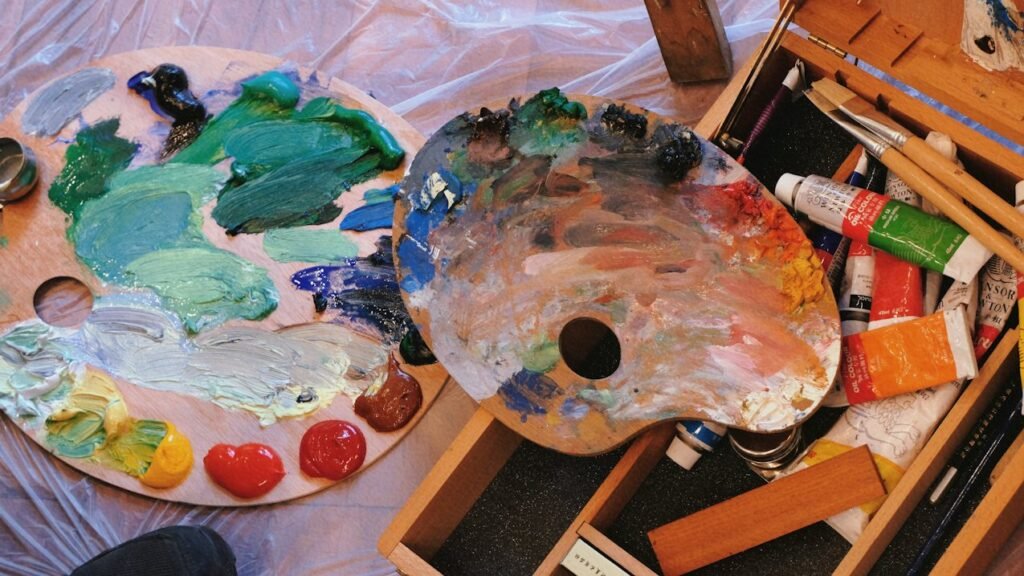
RISD has a long institutional relationship with making.
Consequently, reviewers often pay close attention to material decisions.
Applicants frequently discuss meaning while treating support, surface, scale and facture as secondary concerns.
At RISD, these elements are not secondary.
Strong portfolios demonstrate that material choices generate meaning rather than merely carrying it.
The question is not whether the painting is technically accomplished.
The question is whether the material language of the work is necessary.
Painting as a Contemporary Field
Another common mistake is presenting painting as a closed discipline.
RISD does not operate from a narrow definition of contemporary painting.
Figuration, abstraction, installation, textile-informed work, image appropriation, sculptural painting and expanded painting practices can all succeed.
However, they must still engage painting as a meaningful framework.
Applicants sometimes present photography, installation or mixed-media work without demonstrating why painting remains central to the practice.
That creates uncertainty.
The strongest portfolios expand painting without abandoning it.
Why Technical Skill Alone Is Not Enough
Many rejected applicants are technically stronger than some accepted applicants.
That statement often surprises people.
Yet it reflects a broader truth about graduate admissions.
RISD is selecting future colleagues, not students seeking basic instruction.
As a result, technical skill functions more as an entry requirement than a decisive advantage.
A beautifully painted work may still feel inert.
Meanwhile, a formally unresolved painting may suggest far greater research potential.
Admissions often asks:
- What questions is this artist pursuing?
- How does the work evolve?
- Where might this practice go next?
- What happens under sustained critique?
- Does the artist generate problems worth investigating?
Those questions frequently outweigh pure execution.
The Portfolio Mistakes RISD Applicants Make Most Often
Mistake One: Presenting a Survey Instead of a Practice
Applicants often try to demonstrate versatility.
Therefore, they include everything.
Drawing sits beside sculpture. Sculpture sits beside photography. Photography sits beside unrelated paintings.
The result is breadth without direction.
RISD does not need evidence that you can work in multiple media.
It needs evidence that your artistic decisions accumulate into a coherent enquiry.
Mistake Two: Over-Explaining Weak Work
Some applicants attempt to rescue unsuccessful projects through extensive text.
Unfortunately, this rarely works.
Strong graduate applications allow the work and writing to reinforce one another.
The statement should clarify stakes.
It should not compensate for unresolved visual decisions.
Mistake Three: Confusing Aesthetic Consistency With Depth
Many portfolios achieve visual consistency through colour, composition or subject matter.
However, consistency alone does not create complexity.
Admissions reviewers often look for development.
They want evidence that ideas evolve under pressure.
If every painting arrives at the same conclusion, the work may appear finished rather than alive.
What RISD Wants From the Statement of Purpose
The statement of purpose is frequently misunderstood.
Applicants often treat it as an artist statement.
That is a mistake.
RISD already has the portfolio.
The statement should answer a different question.
Why is graduate study necessary now?
Strong statements typically explain:
- the central tensions within the practice
- why those tensions require further development
- why RISD is the appropriate environment
- how the applicant intends to use the programme
Generic statements weaken otherwise competitive applications.
Specificity matters.
Mentioning critiques, faculty interests, studio culture or thesis structures demonstrates genuine institutional understanding.
The Importance of Critique Culture
One feature distinguishes RISD from many programmes.
Critique is not peripheral.
It sits at the centre of the educational model.
Applicants often underestimate this.
They focus on facilities, reputation or faculty.
Meanwhile, admissions is asking whether the artist can survive sustained intellectual pressure.
Strong applicants demonstrate:
- openness to revision
- ability to articulate decisions
- tolerance for uncertainty
- willingness to challenge assumptions
The portfolio should reveal evidence of this behaviour.
Finished work is less persuasive than work that has clearly undergone transformation.
What Accepted RISD MFA Painting Applicants Often Share
Although RISD does not publish accepted portfolios, patterns emerge repeatedly.
Successful applicants often demonstrate:
An Existing Studio Rhythm
They already make work consistently.
The MFA accelerates an existing practice rather than creating one.
Research Beyond Image-Making
The strongest portfolios reveal reading, looking, collecting, writing and contextual awareness.
Importantly, this research appears embedded within the work.
It does not sit outside it.
Clear Artistic Stakes
The work asks something difficult.
That difficulty may be political.
In other cases, it emerges through form, scale, surface or image construction.
At times, the pressure sits in the material itself.
Regardless, the practice appears driven by necessity rather than preference.
Editorial Discipline
RISD allows applicants to submit up to twenty works.
Strong applicants rarely use all twenty unless every work strengthens the portfolio.
Editing is itself an admissions skill.
How To Assess Whether Your RISD MFA Painting Portfolio Is Competitive
A useful question is not “Is my work good?”
Instead ask:
“What would happen if I spent two more years investigating this?”
If the answer feels obvious, the practice may be too resolved.
If the answer feels impossible, the work may lack direction.
Competitive MFA portfolios often occupy the uncomfortable space between those positions.
They feel developed but unfinished.
They contain conviction. However, they also contain risk.
Most importantly, they suggest future growth.
That future orientation is central to graduate admissions.
RISD is not evaluating what the work has been.
It is evaluating what it might become.
Preparing a RISD MFA Painting Application?
The challenge of the RISD MFA Painting portfolio is not the published requirement. Ten to twenty works sounds straightforward. The difficulty lies in understanding what those works must collectively demonstrate.
RISD is not looking for a technically polished collection of paintings. Nor is it looking for experimentation without structure. The strongest applications show a practice with momentum, material intelligence, critical awareness and enough unresolved pressure to sustain two years of graduate research.
Many applicants misdiagnose the problem. They spend months refining individual works while avoiding harder questions about direction, coherence, research and how the portfolio reads as a whole.
Cadmium is an online-first, artist-led admissions mentorship platform supporting Foundation, BA, BFA, MA, MFA and PhD applicants. Our mentors include practising artists, educators and admissions specialists with extensive experience across highly competitive art school applications.
For RISD applicants, our Portfolio & Admissions Mentorship focuses on identifying repetitive, unresolved or strategically weak work, clarifying the central enquiry driving the practice, strengthening portfolio presentation logic, refining documentation and developing written materials that give the work sharper institutional relevance.
Where writing becomes the obstacle, our Writing & Context Support helps applicants articulate complex practices without collapsing into generic artist-statement language. We also support interview preparation for applicants who need a more precise understanding of how their work operates within contemporary painting discourse.
If your deadline is approaching and the portfolio still feels fragmented, over-resolved or difficult to explain, this is often the point where an external critique becomes most valuable. Cadmium’s 90-minute portfolio review gives applicants a focused read on what is working, what is weakening the submission, and what needs to change before the deadline. You can also book a 1h expert consultation to discuss your RISD route, timeline and application pressure. A stronger application frequently begins with one difficult question: what is the portfolio asking RISD to believe about your future practice?