
The MICA BFA Painting portfolio requirements look simple: 10-15 works, no prompt, no home exam. However, that apparent openness is where many applicants misread Maryland Institute College of Art. They assume a strong set of paintings will be enough. Instead, MICA’s Painting culture asks a more difficult question: can this applicant hold technical discipline and artistic risk in the same practice?
That misconception matters because MICA is not asking for a decorative greatest-hits folder. Nor is it asking for a chaotic display of every experiment an applicant has attempted. The strongest portfolio reads as an argument about a young painter’s capacity to think through images, materials, colour, surface and subject.
For this reason, the admissions task is less about satisfying a checklist and more about making judgement visible. The portfolio has to show what the applicant notices, how they decide, and where the work could go next.
Applying to MICA this year? See how we prepare applicants for MICA.
MICA BFA Painting portfolio requirements: why openness is the trap
MICA’s official undergraduate route is broad at the point of entry. Applicants apply through the official undergraduate admissions route, and the Painting BFA sits within the wider BFA structure. Therefore, the portfolio requirement is not a separate Painting-only admissions gate.
However, serious Painting applicants should not treat that as permission to submit a generic art-school portfolio. MICA’s portfolio preparation guidance asks for 10-15 recent pieces that represent artistic interests, technical skills, ideas, abilities, experience and range. In addition, it stresses clear documentation, careful selection and risk.
That combination is revealing. MICA gives applicants space, but it also expects judgement. A successful portfolio should not feel like a folder assembled the night before submission. It should feel chosen.
The 10-15 works are not a storage limit
The number matters because 10-15 works leave little room for weak evidence. Consequently, every piece must perform a clear role. One half-finished painting, one old classroom exercise, or one copied portrait can alter how the whole submission reads.
Applicants often think more work creates safety. Instead, weak additions suggest poor editing. MICA’s openness therefore makes selection more important, not less.
A competitive Painting portfolio should include finished work, but also enough tension to suggest growth. For example, a disciplined life drawing may sit beside a more unsettled material experiment. Yet the two should still feel connected by looking, subject, surface or decision-making.


MICA Painting is built on “tradition and rebellion”
Notably, MICA’s official Painting major page describes the department through “tradition and rebellion.” This phrase is not branding decoration. It is the clearest clue to how Painting applicants should think.
Tradition means MICA still values drawing, painting skill, colour, surface and formal judgement. However, rebellion means the programme does not want applicants who simply obey inherited models. The portfolio has to show that skill is being used, questioned and stretched.
This is why two opposite portfolios can fail for the same reason. A technically polished portfolio may be too safe. By contrast, an experimental portfolio may lack enough visual discipline to persuade the review committee.
What “tradition” should look like
For MICA, technical ability should appear through specific decisions. Drawing from observation matters, but so do colour relationships, edges, scale, composition and material handling. Therefore, a strong still life is not strong because it looks accurate. It is strong because the applicant has made the looking active.
A conventional painting can work if it carries pressure. For instance, a portrait may reveal sensitivity to flesh, lighting, psychology and cultural representation. However, a copied celebrity image usually tells reviewers very little about how the applicant thinks.
The question is not, “Can you render?” Rather, it is, “Can you make visual decisions that belong to you?”
What “rebellion” should look like
Risk at MICA should look intentional. It may appear through an ambitious scale, an abrasive surface, an unexpected support, a strange colour system, or a movement from painting into object, textile, installation or digital space.
However, risk is not the same as novelty. A messy experiment without control rarely looks brave. It usually looks unfinished.
A stronger risk changes how the work functions. For example, a painting that becomes an object may alter the viewer’s sense of body and space. Similarly, a figurative image that distorts proportion may reveal something specific about memory, discomfort or intimacy.
What reviewers are likely reading in each work
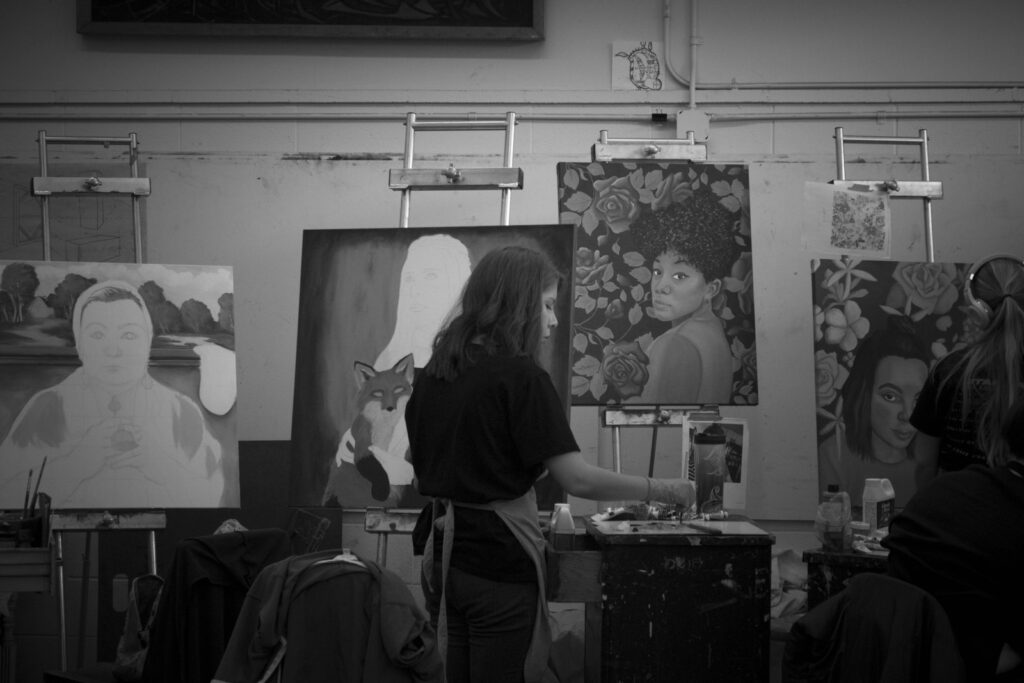
MICA does not publish a numerical rubric for BFA Painting admissions. Nevertheless, its language makes the hierarchy clear. The portfolio is the central evidence of commitment, ability and potential.
Reviewers are unlikely to look at each work as a separate school assignment. Instead, they will read the submission as a pattern of artistic behaviour. They are asking whether the applicant can sustain serious studio work, respond to critique and grow inside a demanding art-school environment.
In practical terms, each work should answer several questions:
- Why does this image or object need to exist?
- What does the handling of colour, surface, line or material reveal?
- Is the work self-directed, or does it feel inherited from a brief?
- Does the portfolio show range without becoming random?
- Can the ideas be seen, rather than only explained?
- Does the documentation let the work read accurately?
This is where many promising applicants lose force. They include individual pieces with merit, but the portfolio does not accumulate meaning. Therefore, the review committee sees activity rather than direction.
For applicants who need a more exacting external read, Cadmium’s Portfolio and Admissions Mentorship focuses on identifying weak, repetitive or unresolved work. It does so before those works enter the submission. The aim is not cosmetic polish. Instead, it is to clarify how the portfolio reads under admissions pressure.
The most common MICA Painting portfolio mistakes
MICA’s requirements appear generous, but generous does not mean loose. In fact, open requirements often expose uncertainty more quickly. Because there is no prompt, applicants cannot hide behind a task.
Several mistakes appear again and again in Painting portfolios for selective art schools:
- Technical competence without authorship. The work is careful, but it could belong to any diligent student.
- Experimentation without visual control. The applicant uses unusual materials, yet the image or object lacks form.
- Too much old or unfinished work. The portfolio starts to look padded rather than selected.
- Disconnected projects. Each piece may be acceptable, but the whole submission does not hold together.
- Poor documentation. Surface, colour, scale and material presence disappear because the photographs are weak.
- Caption dependence. The work becomes interesting only after a long explanation.
- A narrow idea of painting. The applicant assumes MICA only wants traditional oil painting.
- An anti-skill misunderstanding. The applicant assumes experimental openness means drawing and material control no longer matter.
Importantly, these are not minor presentation issues. They change the admissions reading. A portfolio that looks safe, scattered or badly documented can make a serious applicant appear underdeveloped.
The caption cannot rescue the painting
MICA’s guidance stresses the visual expression of ideas and concepts. Therefore, an idea must be visible in the work before the description explains it. A sentence can clarify context, but it cannot manufacture visual force.
This is especially important for applicants working with identity, memory, body, place or cultural history. These subjects can be powerful. However, they become weak when the image simply illustrates a theme.
Titles, media, dimensions and brief notes should be precise. Meanwhile, the work itself should carry the argument. Where written material is part of a wider application, Cadmium’s personal statement and writing support helps applicants articulate practice without turning it into generic admissions language.
How to build a portfolio that fits MICA’s culture
A MICA Painting portfolio should show an applicant who can enter a studio culture and use it seriously. That does not mean arriving as a finished painter. In fact, MICA’s undergraduate structure expects development.
However, the portfolio should already contain evidence of direction. The applicant should show that they are not simply waiting to be assigned a style, subject or method. They have begun to make decisions.
A strong portfolio will usually include:
- drawing or painting that proves sustained looking;
- colour decisions that feel observed rather than decorative;
- surface handling that matters to the image;
- personal subject matter treated with visual intelligence;
- material or formal risk that does not collapse into chaos;
- recent finished work, not nostalgic favourites;
- documentation that respects scale, texture and context;
- enough range to show curiosity, but enough coherence to show judgement.
This is also where applicants need to understand painting expansively. MICA Painting can accommodate drawing, painting, mixed media, textile, object-based work, digital work, installation documentation and time-based documentation. However, the portfolio still needs a visual logic. It cannot become a sample tray.
Figuration can work if it is not academic obedience
Figurative painting remains relevant to MICA, but not as empty demonstration. MICA’s profile of Monica Ikegwu ’20 shows how hyper-realistic portraiture can operate through representation, identity and a serious expansion of subject. That distinction matters for applicants.
A portrait is not automatically conservative. However, a portrait that only repeats a photograph is rarely enough. The stronger question is what the image does with presence, distance, power, intimacy or cultural visibility.
Similarly, family, home, community and memory can be serious material. Yet personal subject matter needs form. Admissions reviewers do not reward confession on its own. They reward visual decisions that make the subject unavoidable.
Expanded painting can work if it remains accountable
MICA’s Painting culture also allows painting to move beyond the canvas. As a result, applicants can include textiles, beaded surfaces, constructed supports, installation images, digital composites or objects that still think like paintings.
However, expanded work must remain accountable to the eye. It needs proportion, surface, placement and material intelligence. Otherwise, the work risks looking like a detour rather than a practice.
This is where applicants often need hard editing. A large mixed-media piece may be compelling in person but unclear in a photograph. Conversely, a smaller painting may carry more visual authority than an ambitious but unresolved installation. Cadmium’s Art School Portfolio Review is designed for this kind of decision, especially when applicants need to know what is actually landing.
Documentation is part of the admissions argument
For Painting applicants, documentation is not administration. It is the way the work enters the room. Therefore, poor photographs can distort the entire application.
MICA advises applicants to use clear images, good lighting and neutral backgrounds. It also notes that installation, performance and time-based work should be documented in context. In addition, applicants should not embed text inside the image file, because information belongs in the submission fields.
This matters intensely for painting. Specifically, surface, glare, cropping, shadow and colour balance can change the reading of a work. Thick paint may look flat. Large work can lose scale. Meanwhile, a careful palette may turn muddy.
Applicants should therefore photograph paintings straight on, avoid visual clutter, and include contextual views only when they add necessary information. For three-dimensional or installation-based work, one clean overview and one detail can often do more than five confusing angles.
When deadlines are close, rushed documentation becomes one of the fastest ways to weaken a strong body of work. Cadmium’s Fast-Track Portfolio Intensive is suited to applicants who need urgent decisions. It focuses on what to keep, what to remove, what to remake and how to present the work clearly before submission.
MICA is not a UK-style Fine Art admissions model
International applicants often misread MICA through a UK Fine Art lens. However, MICA’s admissions structure is different. It uses a US undergraduate art-school model, with a broad BFA entry route, a shared First Year Experience and later specialisation.
Consequently, applicants should not overprepare for a Painting-specific interview while neglecting the portfolio. MICA does offer portfolio reviews and admissions appointments, but the formal first-year application does not appear to depend on a UK-style interview gate.
At the same time, applicants should still be able to speak clearly about the work. National Portfolio Day reviews, admissions conversations and informal feedback contexts can expose whether the applicant understands their own decisions.
The distinction is subtle but important. For MICA, articulation supports the portfolio. It does not replace it. The work must first show visual sensitivity, curiosity, risk and discipline.
How parents should understand the MICA portfolio standard
For parents, MICA’s openness can feel reassuring. There is no home exam, no rigid prompt and no requirement to produce one official style of painting. However, this openness can make the application harder to judge from outside.
A strong school grade does not always equal a competitive MICA portfolio. Similarly, technical ability can mask deeper issues. The applicant may draw well, yet still lack personal direction, material curiosity or evidence of independent studio thinking.
Parents should therefore ask a more precise question. Does the portfolio show a student ready to enter a critique-led studio culture? If the work only proves classroom success, the answer may not be enough.
The best support at this stage does not take over the work. Instead, it helps the applicant see what their decisions are already saying. It also identifies where the portfolio is too safe, too scattered, too dependent on explanation or too weakly documented.
Not Sure Whether Your MICA Painting Portfolio Reads Competitively?
The MICA BFA Painting portfolio requirements are difficult because they appear open. Yet the real standard is precise. MICA wants evidence that an applicant can enter a studio-centred, critique-led BFA and use the freedom with seriousness.
A portfolio built only on technical polish may not be enough. Similarly, a portfolio full of disconnected experiments may miss the point. The strongest applications show drawing intelligence, colour judgement, material awareness, personal direction, risk and the capacity to grow through critique.
Cadmium works with Foundation, BA, BFA, MA, MFA and PhD applicants through an online-first, artist-led admissions mentorship platform. Our mentors include practising artists and admissions specialists with experience across US, UK and international art school applications, including admissions panel experience at leading art schools.
For MICA applicants, Cadmium’s Portfolio and Admissions Mentorship focuses on identifying weak, repetitive or unresolved work, clarifying the central enquiry, refining how the portfolio reads, strengthening documentation and developing application language that gives the practice sharper definition.
Where the writing is the weaker part of an application, our Writing and Research Mentorship helps applicants articulate work with precision, context and institutional relevance.
If a MICA deadline is approaching and the portfolio still feels safe, scattered, over-polished or difficult to explain, this is the moment to get a sharper read. You can apply for Cadmium mentorship or book a call to discuss your route, deadline and which form of support fits the application. A stronger submission usually begins with one uncomfortable question: what is the work asking admissions to believe about you?